 Swedish web site


TDDD83 Computer Engineering - Bachelor Project
Presentation
The submission of the bachelor's thesis includes opposition, presentation, and auscultation, which are integral parts of the examination and take place at the end of the course. All three components are important. A poor presentation or opposition may result in a failing grade, which could lead to a requirement for supplementary work or a complete redo. Both the presentation and the opposition are conducted in pairs or groups of three, and you decide yourselves which members of your own group you wish to work with. The opposition takes place the week before the presentation. All oral components are conducted in English (recommended) or Swedish.
1. Opposition
Opposition
Each opposition session lasts 15 minutes. The opposition should be structured as a discussion and a constructive dialogue between the opponents and the respondents. You should help each other improve the quality of the reports. The opponent's task is to:- critically review the quality of the bachelor's thesis work performed and the bachelor's report.
- identify both weaknesses and strengths.
- engage in a constructive dialogue and discussion about how the work could have been done differently.
- if you need more inspiration, you can consult an external source, for example uppsatsguiden.se
Some practical details:
- Upload your own report to Lisam in the folder "Collaborative workspace/Group XX/Rapport/Opposition", where XX is your group number, along with a change log indicating which actions/changes have been made since the previous submission and where these can be found for each comment the group has received on the report from the course leadership. Agree with the groups you are opposing on when the report should be uploaded to Lisam if there is a request to upload it earlier than the deadline in the TimeEdit schedule.
- When preparing the opposition, reflect on the content and base your work on the Assessment template for bachelor's reports and answer the following questions. The opposition, including the assessment and answers, should be uploaded to Lisam in the same folder where the opponent group's report is located: "Collaborative workspace/Group XX/Rapport-opposition", where XX is the opponent group's number.
- Decide yourselves whether to use a PowerPoint presentation or not.
- An examination requirement is that each individual student must have attended 2 oppositions concerning a project other than their own and the one they opposed.
- Supervisors and the examiner will also make an assessment, which will be communicated to the groups (see the Sprints page and TimeEdit schedule for exact times), and the bachelor's reports approved for presentation will be presented.
- There are WebReg groups to register for. Each group has been assigned 3 WebReg groups, so each group has 3 opportunities to oppose. Each group divides itself into 3 internal subgroups.
Each WebReg group involves 4 different subgroups. In each WebReg group, you can see when and where the opposition takes place and which groups are to oppose.
For example, WebReg group 01: 8:00 Groups: 4,2,3,10 means that for WebReg group 01, the opposition takes place from 8:00 to 9:00 for groups 4, 2, 3, and 10, as follows:
- group 4 opposes group 2
- group 2 opposes group 3
- group 3 opposes group 10.
- group 10 opposes group 4. Each group member must log in to WebReg and register according to the figure below: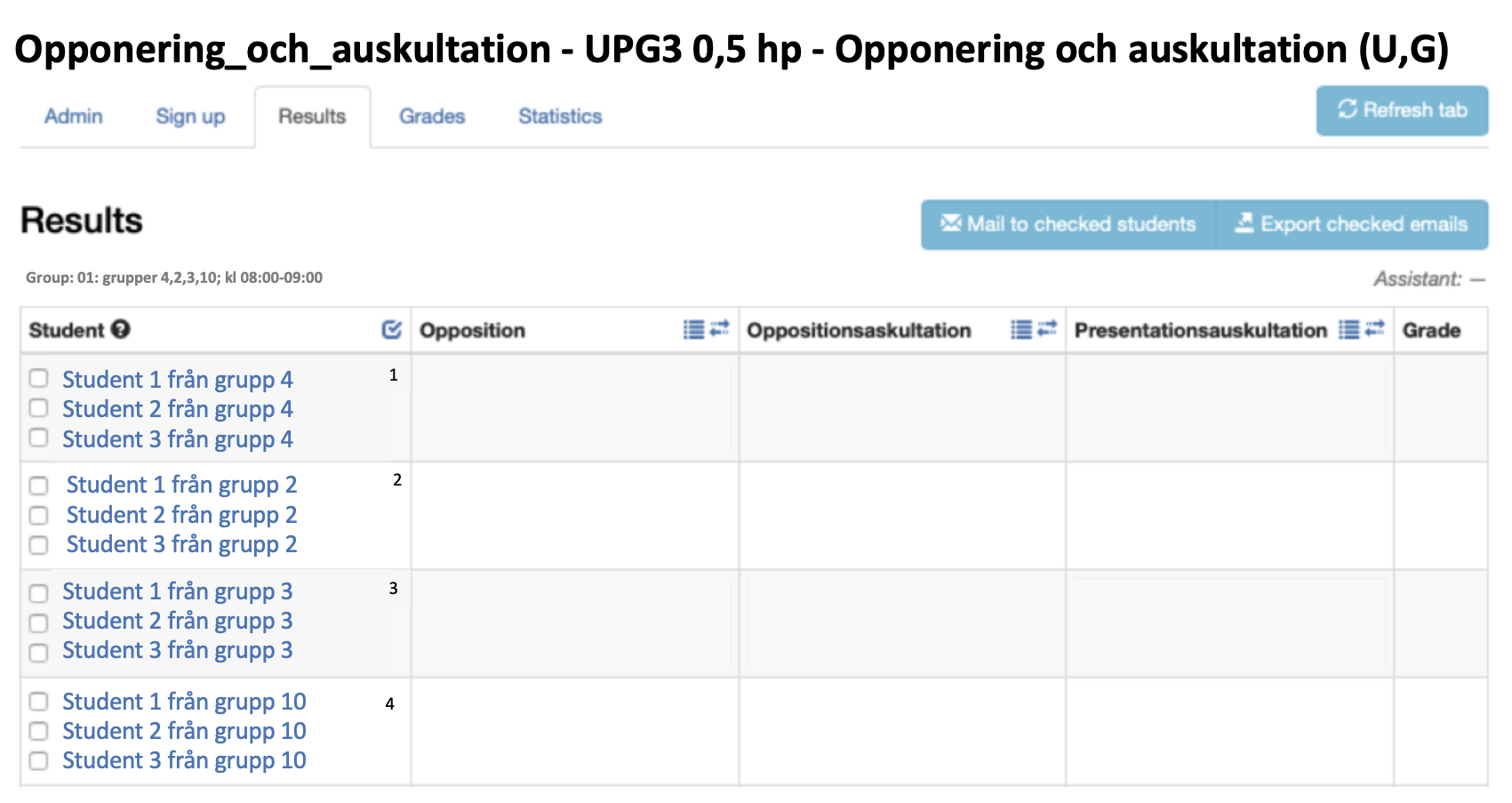
The same principle applies to all WebReg groups. This means that each group receives feedback from 3 other groups.
Remember that the opposition must be conducted both orally and in writing as described above. The written opposition should be uploaded to Lisam in the respondent's folder where the report is located, no later than the same day as the opposition.
-
Go to WebReg to register for an opposition session.
2. Presentation
The final report must be uploaded to Lisam in the folder "Collaborative workspace/Group XX/Rapport/Presentation", where XX is the group number, along with a change log detailing the actions/changes made since the previous submission and their locations, addressing every comment the group received on the report from the course leadership and all opponents.
Each bachelor's thesis presentation should last 30 minutes. The oral presentation must, of course, be well-prepared:
- Reports approved for presentation must be presented.
- The language of the presentation is English or Swedish. We recommend English, as sometimes the only person attending the presentation is a doctoral student with limited Swedish skills. Treat this as an exercise in presenting in English – it's not the end of the world if you stumble over a word or slip in a Swedish term when you can't recall the translation.
- The presentation focuses on the bachelor's thesis report.
- Think through what you want to say and write down key points. 30 minutes is a short time, and you need to cover a lot, so thorough preparation is essential. The presentation should serve as an engaging introduction to the bachelor's thesis report. You should present the research question, describe what you have done, the results you have reached, the problems you encountered and what you failed to solve, the findings, conclusions, what you have learned, and the experiences you are taking away. Choose carefully what you wish to cover. Do not demonstrate the application.
- Decide yourselves whether to use a PowerPoint presentation or not.
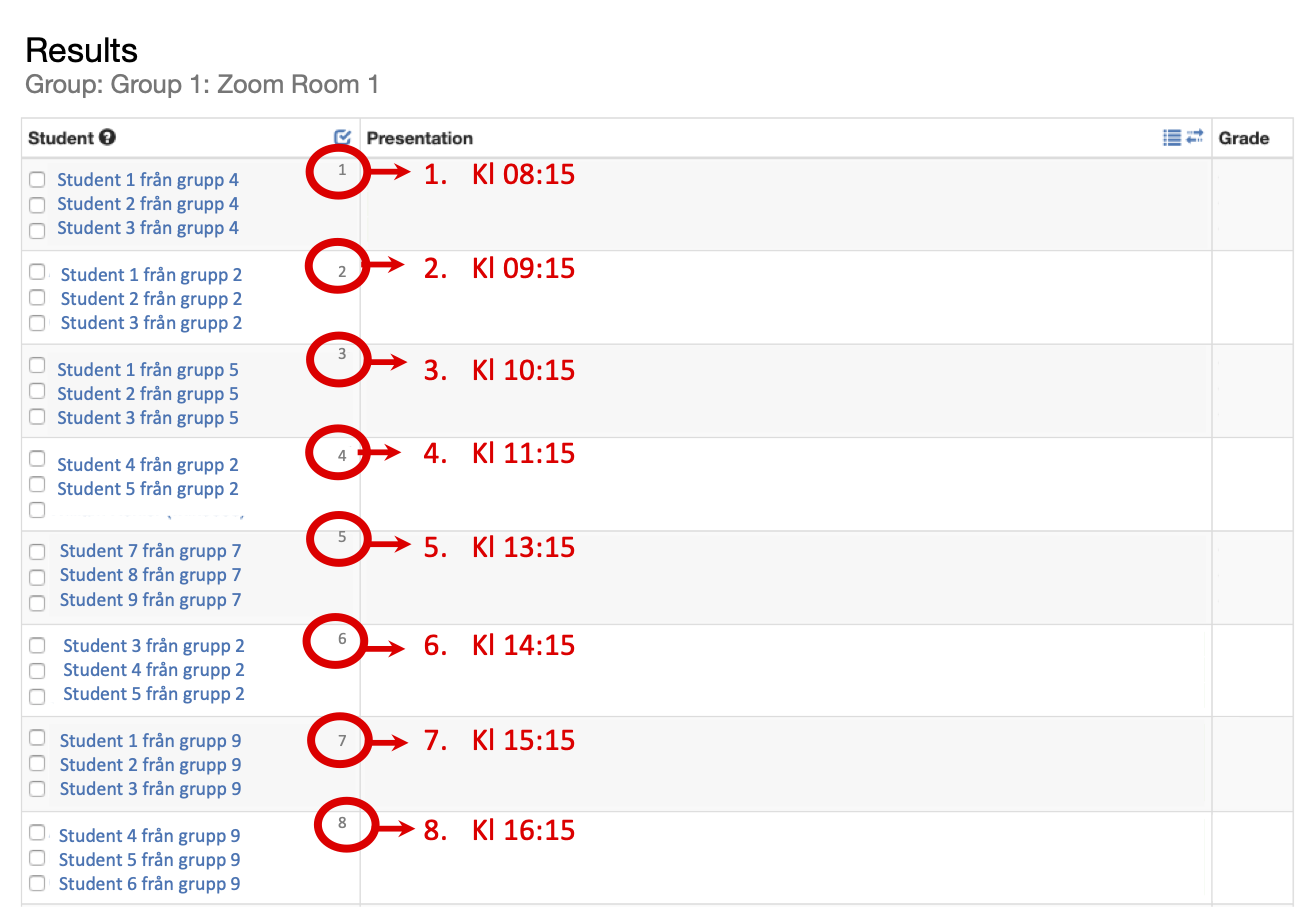
- There will be several parallel presentations during the day (see WebReg!).
- Registration for the presentation is done in WebReg
and it is first-come, first-served, meaning you will get a time slot in the order you register.
3. Auscultation
Auscultation means attending 2 presentations (2 oppositions and 2 presentations) concerning a bachelor's thesis other than one's own and the one the student has opposed. Each student must complete two opposition auscultations and two presentation auscultations as follows:
Opposition Auscultation:
Presentation Auscultation:
Opposition Auscultation:
- Each student must auscultate 2 different oppositions in addition to the one they performed (i.e., beyond their own report and the report they opposed). This means each student attends a total of 4 oppositions for 4 different reports: the opposition on their own report, the respondent's opposition, and oppositions on two other distinct reports.
- During each opposition session the student has registered for, there are a total of 4 reports to be opposed (the student's own report, the report the student is opposing, and two additional reports). If the student is present for the entire opposition session, they have completed the opposition auscultation. For example, for the WebReg group where groups 4, 2, 3, and 10 oppose each other, the following applies:
- student from group 4 opposes group 2 and auscultates reports 3 and 10
- student from group 2 opposes group 3 and auscultates reports 4 and 10
- student from group 3 opposes group 10 and auscultates reports 4 and 2
- student from group 10 opposes group 4 and auscultates reports 2 and 3
- The student must ensure they sign the auscultation attendance list.
- Keep in mind that technical issues are hard to avoid, so assume the times listed above are approximate; arrive a little early and plan for the session to run over time.
Presentation Auscultation:
- Each student must attend 2 different presentations that are neither their own report nor the report they opposed.
- No prior registration is required to attend an auscultation. Simply join a presentation session before it begins. The student must ensure they sign the auscultation attendance list.
- For example, if you belong to group 1 and have opposed group 3, you must attend two other presentations that are not for group 1 or 3, but for two other distinct groups, e.g., group 7 and 9. Note that you must auscultate two different reports; attending the presentation for group 7 twice counts as only one auscultation.
- Keep in mind that technical issues are hard to avoid, so assume the times listed above are approximate; arrive a little early and plan for the session to run over time.
Page responsible: Martin Sjölund
Last updated: 2026-04-16
