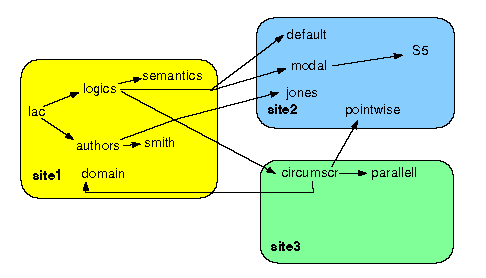
Moreover, the paths do not even have to correspond to real paths within the servers. For instance, there need not be any real path lac/logics/semantics/ anywhere at site no. 1.
Instead of using the "real" links to the pages, "virtual" links are used which are then mapped to real links by virtual link managers at the servers. The vlm:s are programs that are installed at the servers and are executed whenever a page is accessed, usually via a cgi script.
There are two advantages with this schema:
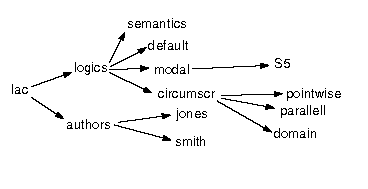
In reality, the different files and directories might be distributed
over several different servers, like in the following picture.
Moreover, the paths do not even have to correspond to real paths within the servers. For instance, there need not be any real path lac/logics/semantics/ anywhere at site no. 1.
Now assume somebody wants to read a document about modal logics and sends the request http://site1/lac/logics/modal/index.html as in step (1) below.
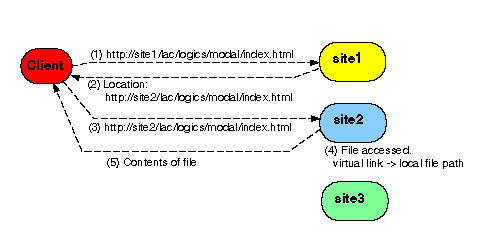
The lac component in the path is actually a call to a vlm script that invokes a vlm at site 1 with the remainder logics/modal/index.html of the path and approriate maps.
The vlm recognizes that logics/modal is located at site 2,
and therefore redirects the request to site 2 in steps (2) and (3).
Next, the vlm at site 2 recognices that logics/modal is actually located at site 2. The link is transformed to the corresponding real file path in step (4), e.g. /info/www/ext/lac-dir/modal-logics/index.html, and the file is fetched and sent to the client in step (5).
For the technically interested, detailed instructions for setting up a virtual link manager are available (however, the software is currently not publically available).